Check out this interview I did recently for "A Body for Radio," the podcast of The Apothetae theatre in New York City. The Apothetae's founder, Gregg Mozgala, poses some questions about theatre training for actors with disabilities.
The Apothetae - A Body for Radio 12/13/12
Saturday, December 15, 2012


The Quantum Theory of Regan
I'm a big fan of words. Choosing them wisely, knowing their meaning, comparing them. (Miniature side tangent...what is with the resurgence of the word "retard"? Maybe it never un-surged, but recently I've noticed people using it more frequently. Personally, I think it gets thrown around too much. Like many other slang terms, it's hurtful towards a certain population of people, and those who utter it are often unaware of its impact. Moreover, this population often doesn't have a voice to defend itself, so "retard" is a coward's insult. And even MORE over, there are SO many more interesting insults!!! Taking a cue from Shakespeare, how about a froward, fat-kidneyed flax-wench? Or, a pribbling, elf-skinned maggot-pie? Come on, folks, be a little more creative.)
Back to my point. I love words, and recently I was thinking about two specific words and the way in which they relate to my life choices and my acting: PROBABILITY and POSSIBILITY.
I believe that anything is possible. So does quantum physics. In fact, according to the basic quantum physics lessons I have acquired from a recent reading of Stephen Hawking's book The Grand Design, as well as a couple of PBS NOVA shows (which obviously makes me an expert...ha), quantum theory hypothesizes that every particle of matter - whether it be a photon, human, or galaxy - has infinite possible histories. In moving from point A to point B, we travel every possible pathway, and it is simply that one of these pathways in being observed in our present reality that makes it "real." The way I like to interpret this is to say that I am essentially living every possible outcome of my life at once; at this juncture I'm a baker, a lawyer, a doctor, a mother, or still standing on two feet. Regan being a wheelchair-using actor is simply one of a multitude of pathways.
In addition, quantum physics asserts that you cannot predict the future. You can only predict the probability of a certain outcome. So, from this point forward, anything is possible for me. Or you. Or anyone. I could become an Oscar Award Winner. I could also un-paralyze myself.
Now, here's where the the word distinction comes in. Just because something is POSSIBLE doesn't mean that it's particularly PROBABLE. It is POSSIBLE that I could win an Oscar or feel and move my lower half again, but the PROBABILITY of either of these occurring is likely lower than me becoming a paralegal. Or a trash truck driver. However, that doesn't necessarily deter me, since I know the possibility exists. As Jim Carrey's character holds on to the slim possibility of dating his dream woman in Dumb and Dumber - "So, you're saying there's a chance!" - I will honor (albeit hesitantly) the possibility that I could win an Oscar, or walk again.
On occasion, another person will jubilantly propose one of these possibilities to me, as though it is something I've never considered. It happened to me frequently after my car accident. "You know," he/she would say, "you never know what could happen. I saw this article/video/news story about a guy who (insert inspirational miracle story here), and so you never know." And, even though at times my inner self would say, "You crazy, insensitive, rude-ass mofo, you have no idea what you're talking about, and you're taking me back to a place of darkness where I have no desire to be"...I would never say this. Because, when it came down to it, this crazy, insensitive, rude-ass mofo was right: I could not prove that this possibility of me walking again or being healed was false. It may be improbable, but not impossible. So says quantum physics.
While we CAN predict human patterns and probabilities, but we cannot predict the future. We cannot even fully explain our current existence. Humans can guess, and philosophize, and reason, and pray. But it ultimately comes back to our lived experience, here and now, coupled with belief, or faith...whatever you want to call it. For me, I'm paralyzed from an injury. And, let's be honest, this could mean that my body, a living organism that is now slightly compromised, could expire sooner than others. And don't say, "Oh, Regan, don't say that, you never know." True, I don't know for sure, but it's more probable. I might die sooner that other people who don't have the complications of a spinal cord injury, such as premature osteoporosis, decreased circulation, skin breakdown, atrophy, etc. etc. It's a here-and-now fact that I'm at peace with, so just deal with it. :-)
And in fact, I feel empowered by it. If ANYTHING is possible, why not spend individual resources pursuing the one possibility that I'm most passionate about, no matter how slight, rather that going for the possibility that is more probable, but not my truest passion?
I posed a question to several friends tonight: if you had the choice of living the next ten years of your life doing exactly what you feel passionate about, or spending those ten years not pursuing your passion but engaging in activities that would buy you an additional ten years, what would you do? Being that my friends are mostly passionate artistic actors, they all chose the former: live fewer years, but do what you're passionate about.
As I've worked my way through the MFA acting program at UCSD, there's no question it's taken a toll on me...physically, mentally, emotionally, every "lly" you can think of, and I still have half a year left. I often reach check-in points at the end of a quarter where I realize that I've been more tired, in pain, and run-down than I had realized. In my day-or-so of exhausted wallowing I often ask, is this worth it? Should I continue on this intense path of being an actor, even if it depletes my already-compromised resources more rapidly? Or, should I abandon the struggle of acting and direct my resources to something that might be more "healthy," like intense physical rehab-like training that could lead me toward the possibility of regaining some function that I had thought was lost for good, and might buy me more years? Will my life truly be more meaningful if it lasts longer, or if I live it with a smidgeon of more tingling in my psoas muscle?
Ultimately, everyone has a different answer. Some will take a paralegal position or trash truck job in order to buy the space they need to pursue their greatest passion. They make a sacrifice, but they gain the opportunity to live in what they love during the off-time. Or, some will be the paralegal or trash truck driver simply because it's easier than another road, and they don't have the energy for anything more. And others will cringe at the thought of a paralegal or trash truck career. But no one can be faulted for how they decide to manage their life resources (unless they're knowingly hurting or inhibiting someone else).
I will likely always wrestle with the question of what is "best" for me, particularly because I don't have my very own Stephen Hawking who sits next to me at Starbucks and calculates the probabilities of my life in order to direct me one way. "Stephen, how's your Frappucino?" I'd ask. "Well, Regan, my taste buds say it's good. But if I may, my Frappucino should not be your concern. Your personal quantum statistical analysis says you should stop spending your money on alternative health modalities and get headshots, because the probability of you getting cast on Modern Family is .000023% greater than that of you regaining feeling in your right trochanter." Right-o, Stephen. (Perhaps this scenario is a reality in another dimension of space-time.)
Yet, even if I cannot have my life statistically analyzed by quantum theorists, I have life experience that reinforces quantum theory: I cannot predict the future. Eleven years ago when I was forecasting the next decade, my predictions were all WAY off. But the reality of my current life, despite - or perhaps because of - challenges or pain or struggle, is more glorious than I ever could have predicted.
In addition, quantum theories also assert that the abnormalities of the universe are what allowed for life to be possible. I cannot predict whether I'll be around for 50 years, or a week. But, wheeling around in my chair, I am essentially an abnormality of the universe, or at least of our present reality. So, perhaps in my Abby Normal (thank you, Young Frankenstein) embodiment, I could function like a small window out of this present reality to something we've never considered. In a way, my existence as an injured person who now lives within a slightly modified set of physical properties is more miraculous than if I were to walk again.
So, back to POSSIBILITY and PROBABILITY, and throwing my resources toward doing what I love and chasing that dream of a life in performance, or using my resources to try to prolong my existence, and regain feeling, movement, and function that I've lost in my body.
If I focus on living the existence I've been dealt - no matter how long it lasts or how far it gets me - rather than spending my time trying to get back to some human ideal I no longer embody, which will be more fruitful? In the end, which will make me more proud of the life I've led?
All I can say is, I hope to take something that's POSSIBLE, and make it PROBABLE. Or, if nothing else, I'll die trying. Basically, they'd better figure out a way to get a wheeling person up on to the red carpet Oscar platforms with Ryan Seacrest, because I'm a-comin'.

Back to my point. I love words, and recently I was thinking about two specific words and the way in which they relate to my life choices and my acting: PROBABILITY and POSSIBILITY.
I believe that anything is possible. So does quantum physics. In fact, according to the basic quantum physics lessons I have acquired from a recent reading of Stephen Hawking's book The Grand Design, as well as a couple of PBS NOVA shows (which obviously makes me an expert...ha), quantum theory hypothesizes that every particle of matter - whether it be a photon, human, or galaxy - has infinite possible histories. In moving from point A to point B, we travel every possible pathway, and it is simply that one of these pathways in being observed in our present reality that makes it "real." The way I like to interpret this is to say that I am essentially living every possible outcome of my life at once; at this juncture I'm a baker, a lawyer, a doctor, a mother, or still standing on two feet. Regan being a wheelchair-using actor is simply one of a multitude of pathways.
In addition, quantum physics asserts that you cannot predict the future. You can only predict the probability of a certain outcome. So, from this point forward, anything is possible for me. Or you. Or anyone. I could become an Oscar Award Winner. I could also un-paralyze myself.
Now, here's where the the word distinction comes in. Just because something is POSSIBLE doesn't mean that it's particularly PROBABLE. It is POSSIBLE that I could win an Oscar or feel and move my lower half again, but the PROBABILITY of either of these occurring is likely lower than me becoming a paralegal. Or a trash truck driver. However, that doesn't necessarily deter me, since I know the possibility exists. As Jim Carrey's character holds on to the slim possibility of dating his dream woman in Dumb and Dumber - "So, you're saying there's a chance!" - I will honor (albeit hesitantly) the possibility that I could win an Oscar, or walk again.
On occasion, another person will jubilantly propose one of these possibilities to me, as though it is something I've never considered. It happened to me frequently after my car accident. "You know," he/she would say, "you never know what could happen. I saw this article/video/news story about a guy who (insert inspirational miracle story here), and so you never know." And, even though at times my inner self would say, "You crazy, insensitive, rude-ass mofo, you have no idea what you're talking about, and you're taking me back to a place of darkness where I have no desire to be"...I would never say this. Because, when it came down to it, this crazy, insensitive, rude-ass mofo was right: I could not prove that this possibility of me walking again or being healed was false. It may be improbable, but not impossible. So says quantum physics.
While we CAN predict human patterns and probabilities, but we cannot predict the future. We cannot even fully explain our current existence. Humans can guess, and philosophize, and reason, and pray. But it ultimately comes back to our lived experience, here and now, coupled with belief, or faith...whatever you want to call it. For me, I'm paralyzed from an injury. And, let's be honest, this could mean that my body, a living organism that is now slightly compromised, could expire sooner than others. And don't say, "Oh, Regan, don't say that, you never know." True, I don't know for sure, but it's more probable. I might die sooner that other people who don't have the complications of a spinal cord injury, such as premature osteoporosis, decreased circulation, skin breakdown, atrophy, etc. etc. It's a here-and-now fact that I'm at peace with, so just deal with it. :-)
And in fact, I feel empowered by it. If ANYTHING is possible, why not spend individual resources pursuing the one possibility that I'm most passionate about, no matter how slight, rather that going for the possibility that is more probable, but not my truest passion?
I posed a question to several friends tonight: if you had the choice of living the next ten years of your life doing exactly what you feel passionate about, or spending those ten years not pursuing your passion but engaging in activities that would buy you an additional ten years, what would you do? Being that my friends are mostly passionate artistic actors, they all chose the former: live fewer years, but do what you're passionate about.
As I've worked my way through the MFA acting program at UCSD, there's no question it's taken a toll on me...physically, mentally, emotionally, every "lly" you can think of, and I still have half a year left. I often reach check-in points at the end of a quarter where I realize that I've been more tired, in pain, and run-down than I had realized. In my day-or-so of exhausted wallowing I often ask, is this worth it? Should I continue on this intense path of being an actor, even if it depletes my already-compromised resources more rapidly? Or, should I abandon the struggle of acting and direct my resources to something that might be more "healthy," like intense physical rehab-like training that could lead me toward the possibility of regaining some function that I had thought was lost for good, and might buy me more years? Will my life truly be more meaningful if it lasts longer, or if I live it with a smidgeon of more tingling in my psoas muscle?
Ultimately, everyone has a different answer. Some will take a paralegal position or trash truck job in order to buy the space they need to pursue their greatest passion. They make a sacrifice, but they gain the opportunity to live in what they love during the off-time. Or, some will be the paralegal or trash truck driver simply because it's easier than another road, and they don't have the energy for anything more. And others will cringe at the thought of a paralegal or trash truck career. But no one can be faulted for how they decide to manage their life resources (unless they're knowingly hurting or inhibiting someone else).
I will likely always wrestle with the question of what is "best" for me, particularly because I don't have my very own Stephen Hawking who sits next to me at Starbucks and calculates the probabilities of my life in order to direct me one way. "Stephen, how's your Frappucino?" I'd ask. "Well, Regan, my taste buds say it's good. But if I may, my Frappucino should not be your concern. Your personal quantum statistical analysis says you should stop spending your money on alternative health modalities and get headshots, because the probability of you getting cast on Modern Family is .000023% greater than that of you regaining feeling in your right trochanter." Right-o, Stephen. (Perhaps this scenario is a reality in another dimension of space-time.)
Yet, even if I cannot have my life statistically analyzed by quantum theorists, I have life experience that reinforces quantum theory: I cannot predict the future. Eleven years ago when I was forecasting the next decade, my predictions were all WAY off. But the reality of my current life, despite - or perhaps because of - challenges or pain or struggle, is more glorious than I ever could have predicted.
In addition, quantum theories also assert that the abnormalities of the universe are what allowed for life to be possible. I cannot predict whether I'll be around for 50 years, or a week. But, wheeling around in my chair, I am essentially an abnormality of the universe, or at least of our present reality. So, perhaps in my Abby Normal (thank you, Young Frankenstein) embodiment, I could function like a small window out of this present reality to something we've never considered. In a way, my existence as an injured person who now lives within a slightly modified set of physical properties is more miraculous than if I were to walk again.
So, back to POSSIBILITY and PROBABILITY, and throwing my resources toward doing what I love and chasing that dream of a life in performance, or using my resources to try to prolong my existence, and regain feeling, movement, and function that I've lost in my body.
If I focus on living the existence I've been dealt - no matter how long it lasts or how far it gets me - rather than spending my time trying to get back to some human ideal I no longer embody, which will be more fruitful? In the end, which will make me more proud of the life I've led?
All I can say is, I hope to take something that's POSSIBLE, and make it PROBABLE. Or, if nothing else, I'll die trying. Basically, they'd better figure out a way to get a wheeling person up on to the red carpet Oscar platforms with Ryan Seacrest, because I'm a-comin'.
Regan in Elizabeth I (November 2012, photo by Jim Carmody)
Sunday, July 29, 2012
Accessible theatre solutions
What does it take to make theatre more accessible to actors with disabilities? The answer: not much.
I thought I'd give a little window into a few of the solutions that were devised for me this past school year in plays or dance shows to meet some of the minor unique needs I came across in costuming, staging, or elsewhere in performance.
1. Warming elements for a cold pool shoot: In February, 2012, I performed in a dance theatre show directed by Janet Hayatshahi called The Rest is Silence. The show captured the death experiences of 8 female Shakespearean characters, and I played Ophelia from Hamlet (who drowns in the play). One element of the show was a video showing Ophelia (me) "drowning." We filmed the scene in an unheated outdoor pool in December, and since I can't feel anything below my chest and my body temperature does not regulate "normally" due to my spinal cord injury, the crew brought hairdryers, hot tea, and towels for me to warm up immediately after I exited the pool. (The non-paralyzed got freezing in the pool, too!) I was only able to stay in the pool for about a minute before the cold water was unbearable...it literally took my breath away. But we got the shot, and it was projected onto a shower curtain above a bathtub during the show.
 2. Custom padded body suit for crawling across the floor: In the same dance show, all of the Shakespearean female characters advanced toward the audience in a line at the end. To enhance the imagery of me drowning as Ophelia, I was helped out of my chair onstage by a fellow dancer during in segment of the show, and then had to pull myself across the floor as the line of women moved. However, since I can't feel where the bony prominences of my lower extremities may have been banging, rubbing, or scraping the stage floor as I pulled myself, I requested that we add some padding to whatever I was wearing. brilliant folks at the La Jolla Playhouse costume shop measured my bony outcroppings on my hips, tailbone, knees, and ankles, and put padding into custom-sewn, stretchy undergarments (like Spanx) that I wore underneath my white dress to protect my skin. Amazing!


3. Umbrella attached to chair, rug over pool slats: In the fall, I played Feklusha in Ostrovsky's The Storm. I was supposed to be a traveling pilgrim, and they wanted me to have an umbrella. However, wheeling with your hands and holding an umbrella is quite difficult, so they attached a removable umbrella to the back of my chair. Additionally, the set was centered around a large 1-foot-deep pool, over which wooden slats were laid. To prevent my front casters from getting stuck in some of the wider spaces between the slats when I turned my chair, we put a rug down over part of the slats (below).
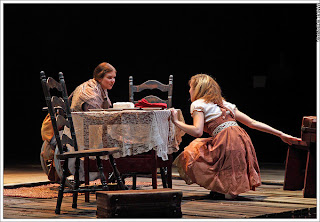
4. Set ramps: The masters-level set designers at UCSD are amazing, and often design complicated, multi-tiered sets that include stairs. They have therefore built ramps into the sets on multiple shows to enable me to access different tiers. Sometimes they are hidden, such as in Small Prophecies, below, where the ramp was behind the back wall.

Other times, they are stylistically incorporated into the set, such as in Gas House Baby (below).
 5. Padding for period wheelchairs: In The Glass Menagerie, we decided to use a somewhat-period wheelchair (the show is set in the 1930s...we did not have a wheelchair from that time frame, so instead used one from approximately the 1950s that the La Jolla Playhouse had in its props stash). Any time I use a wheelchair that is not my own, it's a challenge. My wheelchair is custom fit to the measurements and support needs of my body, and so when I use a different chair, it's like a walking person switching out their legs! Therefore, I usually spend several hours backstage at the beginning of the process experimenting with pillows, cushions, and other padding for me to get to a point where I can comfortably, effectively, and safely wheel. Moreover, the chair we used for Menagerie was rather rusty, had a sling seat (which basically provides no spinal support for my paralyzed and already-unstable abdomen), had brakes that were basically ineffective, squishy rubber tires with no tread, and wasn't really meant to be self-propelled in the way that contemporary chairs are. So, it was a bitch to maneuver. But, after I hid cushions and pillows under an afghan on the chair, and greased the axles up with silicon, it was more workable. And it looked great!


6. Snaps to secure a shoulder shawl: In Blood and Gifts, I played an American Senator's wife, and was fortunate to wear a snazzy blue gown. The costumer wanted to use a shoulder shawl, but with the slick material it kept falling off my shoulders as I wheeled, and risked getting caught under my wheels and inhibiting the classy, smooth rhythm I wanted for the character. So, snaps were added to attach the shawl to the dress, and also secure it under my arms so it would stay put without my hands holding it. Voila!
 Simple, accessible solutions brought to you by common sense and creative minds. :-)
I thought I'd give a little window into a few of the solutions that were devised for me this past school year in plays or dance shows to meet some of the minor unique needs I came across in costuming, staging, or elsewhere in performance.
1. Warming elements for a cold pool shoot: In February, 2012, I performed in a dance theatre show directed by Janet Hayatshahi called The Rest is Silence. The show captured the death experiences of 8 female Shakespearean characters, and I played Ophelia from Hamlet (who drowns in the play). One element of the show was a video showing Ophelia (me) "drowning." We filmed the scene in an unheated outdoor pool in December, and since I can't feel anything below my chest and my body temperature does not regulate "normally" due to my spinal cord injury, the crew brought hairdryers, hot tea, and towels for me to warm up immediately after I exited the pool. (The non-paralyzed got freezing in the pool, too!) I was only able to stay in the pool for about a minute before the cold water was unbearable...it literally took my breath away. But we got the shot, and it was projected onto a shower curtain above a bathtub during the show.


3. Umbrella attached to chair, rug over pool slats: In the fall, I played Feklusha in Ostrovsky's The Storm. I was supposed to be a traveling pilgrim, and they wanted me to have an umbrella. However, wheeling with your hands and holding an umbrella is quite difficult, so they attached a removable umbrella to the back of my chair. Additionally, the set was centered around a large 1-foot-deep pool, over which wooden slats were laid. To prevent my front casters from getting stuck in some of the wider spaces between the slats when I turned my chair, we put a rug down over part of the slats (below).

4. Set ramps: The masters-level set designers at UCSD are amazing, and often design complicated, multi-tiered sets that include stairs. They have therefore built ramps into the sets on multiple shows to enable me to access different tiers. Sometimes they are hidden, such as in Small Prophecies, below, where the ramp was behind the back wall.

Other times, they are stylistically incorporated into the set, such as in Gas House Baby (below).


6. Snaps to secure a shoulder shawl: In Blood and Gifts, I played an American Senator's wife, and was fortunate to wear a snazzy blue gown. The costumer wanted to use a shoulder shawl, but with the slick material it kept falling off my shoulders as I wheeled, and risked getting caught under my wheels and inhibiting the classy, smooth rhythm I wanted for the character. So, snaps were added to attach the shawl to the dress, and also secure it under my arms so it would stay put without my hands holding it. Voila!

Saturday, February 4, 2012
San Diego Update!
Fact: I've been rather busy since my last blog in September. September?! Ouch!!!
Another Fact: I'm planning to write another blog entry soon, so don't fret, and stay tuned.
Indisputable Fact: My friend John Moore is an amazing writer, and just composed a SWELL article about me, which also serves as a nice update.
So, here it is - read away!
PHAMALY Actor Regan Linton Works Her Magic in San Diego - by John Moore
I'm looking forward to celebrating on March 6th, which will be the 10-year anniversary of my injury. In the next couple of weeks, I'll share some thoughts about my experiences of the last 10 years on my blog. So, keep an eye out!
R :-)
Another Fact: I'm planning to write another blog entry soon, so don't fret, and stay tuned.
Indisputable Fact: My friend John Moore is an amazing writer, and just composed a SWELL article about me, which also serves as a nice update.
So, here it is - read away!
PHAMALY Actor Regan Linton Works Her Magic in San Diego - by John Moore
I'm looking forward to celebrating on March 6th, which will be the 10-year anniversary of my injury. In the next couple of weeks, I'll share some thoughts about my experiences of the last 10 years on my blog. So, keep an eye out!
R :-)
Saturday, September 17, 2011
25 Life Lessons from MFA I
I finished my first MFA year in June, and then took several months to process the experience - hence my long break from blogging. But, I'm back! And, here are some of the new lessons I learned - or old lessons I rediscovered - after year #1 of acting school.

UCSD MFA Class of 2013
1. A good friend told me once that one of the worst things in the world is to feel insignificant...true. And one of the worst things to DO to someone else is to make him/her feel insignificant...also true. And yet, the truest thing is, in the larger scheme, we are all terribly insignificant.
2. To some kids, wheelchairs are entertaining playground equipment that transport fascinating passengers. To some adults, they are scary, inexplicable, dangerous impediments that elicit recoiling uncertainty or emotional walls. To OTHER adults that allow themselves a child-like expansion of the mind, wheelchairs are engineering delights, movement marvels, interpersonal architecture, and endless sources of intrigue.
3. The corner-dweller on the freeway off-ramp holding a sign that says "SMILE!" may just be the most enlightened genius of us all.
4. Sometimes people just need a bit of space to be pissy. And, it's helpful when they have the ability to communicate that they need some space to be pissy, rather than letting you wonder if it's about you.
5. It's not about you. Really. Don't take it so personally. (Oh, and if it IS about you, it's up to them to tell you. But, again, it's not.)
6. There are two choices with bullshit that arises in life: address it, or let it go. Okay, I guess three, because you can also address it and then let it go.
7. Beauty, talent, and sanity are contextual. So, if you're feeling like you're not beautiful, or not talented, or not sane, maybe you're just in the wrong environment. Go somewhere else and be with someone different - you'll feel better.
8. Frozen yogurt shops that put toppings UNDERNEATH yogurt rather than on top are not just selling a gimmick...they are promoting a genius strategy of enhancing frozen-artificially-flavored-milk-water that leaves the consumer talking endlessly about "what a great idea it is!" while enjoying a mess-free lap or table area.
9. Even with abounding technology that supposedly helps us to stay connected to other people, it really is difficult to stay truly connected to someone in the absence of semi-regular human-to-human in-person contact. (Hmmm...I sense a lesson here about social networking...)
10. There is no absolute definition of "good" acting. My present opinion is that "good" acting requires a strong sense of self, a willingness to share oneself honestly, and being lucky enough to material that suits you.
11. People are different. Period. Some like to get naked. Some prefer sleep over food. Some enjoy In 'N Out over Five Guys. Some speak Chinese. Some leave social situations abruptly and inexplicably. Some run at midnight. Some detest playing board games. Some like the elephant-like texture and intricacies of aged skin. Some love Disney. Some hear harmony before lyrics. Some are obsessed with football, others like horror movies, others thrive on intellectual sparring, and still others enjoy design concepts of food plating. All DIFFERENT. And it's okay for everyone to be different as long as we respect others' differences. Different strokes for different folks.
12. Humans in the first years of their lives are brilliant and awesome, and those of us who have lived multiple decades should make it a point to garner wisdom from the "newbies" on a regular basis.
13. We should also garner wisdom from humans in the final years of their lives.
14. Yet, being old, famous, or accomplished shouldn't necessarily give you license to be verbose, conceited, or patronizing...we all have more to learn, no matter our age.
15. It's okay to NOT like something...you can still respect its existence and learn from it.
16. People from Denver can be "smiley," which makes it harder to form long, open "ahh"-like vowels in speech. Still, I'm happy to be smiley. :-)
17. You can know people so deeply and intimately that you can predict their emotions, and yet simultaneously know them so little that you're unaware of where they grew up or how many siblings they have. Weird.
18. Even the most solid, refined, and sacred life truths have the potential to be challenged and refuted.
19. Life is like one big improvisational theatre game, and perhaps we should live it with the improvisational philosophy of "yes, and...", and just go with the flow.
20. Science and art are on the same quest: to create, discover, or assign meaning to the inexplicable elements of life. They just embark on the quest using different languages.
21. SO many challenges in life are largely based on people's reluctance to communicate openly and honestly. If people would just get their junk on the table, minimize their egos, and talk it out with love and respect, I bet would could achieve the greatest of feats (including getting more people with disabilities into entertainment, and world peace).
22. Meerkats - as well as other animals - naturally embody the principles of Alexander technique (whole body, lengthen and widen, letting go) that human performers strive for years to attain. Fascinating.
23. Start with #1: care for yourself so you can care for others. And, hold yourself accountable before you move to hold others accountable.
24. Baby steps.
25. I'm alive, and therefore I can.
I think 25 lessons is plenty, even though I could write 1,000. There are more to come.


UCSD MFA Class of 2013
(photo credit: Manny Rotenberg)
2. To some kids, wheelchairs are entertaining playground equipment that transport fascinating passengers. To some adults, they are scary, inexplicable, dangerous impediments that elicit recoiling uncertainty or emotional walls. To OTHER adults that allow themselves a child-like expansion of the mind, wheelchairs are engineering delights, movement marvels, interpersonal architecture, and endless sources of intrigue.
3. The corner-dweller on the freeway off-ramp holding a sign that says "SMILE!" may just be the most enlightened genius of us all.
4. Sometimes people just need a bit of space to be pissy. And, it's helpful when they have the ability to communicate that they need some space to be pissy, rather than letting you wonder if it's about you.
5. It's not about you. Really. Don't take it so personally. (Oh, and if it IS about you, it's up to them to tell you. But, again, it's not.)
6. There are two choices with bullshit that arises in life: address it, or let it go. Okay, I guess three, because you can also address it and then let it go.
7. Beauty, talent, and sanity are contextual. So, if you're feeling like you're not beautiful, or not talented, or not sane, maybe you're just in the wrong environment. Go somewhere else and be with someone different - you'll feel better.
8. Frozen yogurt shops that put toppings UNDERNEATH yogurt rather than on top are not just selling a gimmick...they are promoting a genius strategy of enhancing frozen-artificially-flavored-milk-water that leaves the consumer talking endlessly about "what a great idea it is!" while enjoying a mess-free lap or table area.
9. Even with abounding technology that supposedly helps us to stay connected to other people, it really is difficult to stay truly connected to someone in the absence of semi-regular human-to-human in-person contact. (Hmmm...I sense a lesson here about social networking...)
10. There is no absolute definition of "good" acting. My present opinion is that "good" acting requires a strong sense of self, a willingness to share oneself honestly, and being lucky enough to material that suits you.
11. People are different. Period. Some like to get naked. Some prefer sleep over food. Some enjoy In 'N Out over Five Guys. Some speak Chinese. Some leave social situations abruptly and inexplicably. Some run at midnight. Some detest playing board games. Some like the elephant-like texture and intricacies of aged skin. Some love Disney. Some hear harmony before lyrics. Some are obsessed with football, others like horror movies, others thrive on intellectual sparring, and still others enjoy design concepts of food plating. All DIFFERENT. And it's okay for everyone to be different as long as we respect others' differences. Different strokes for different folks.
12. Humans in the first years of their lives are brilliant and awesome, and those of us who have lived multiple decades should make it a point to garner wisdom from the "newbies" on a regular basis.
13. We should also garner wisdom from humans in the final years of their lives.
14. Yet, being old, famous, or accomplished shouldn't necessarily give you license to be verbose, conceited, or patronizing...we all have more to learn, no matter our age.
15. It's okay to NOT like something...you can still respect its existence and learn from it.
16. People from Denver can be "smiley," which makes it harder to form long, open "ahh"-like vowels in speech. Still, I'm happy to be smiley. :-)
17. You can know people so deeply and intimately that you can predict their emotions, and yet simultaneously know them so little that you're unaware of where they grew up or how many siblings they have. Weird.
18. Even the most solid, refined, and sacred life truths have the potential to be challenged and refuted.
19. Life is like one big improvisational theatre game, and perhaps we should live it with the improvisational philosophy of "yes, and...", and just go with the flow.
20. Science and art are on the same quest: to create, discover, or assign meaning to the inexplicable elements of life. They just embark on the quest using different languages.
21. SO many challenges in life are largely based on people's reluctance to communicate openly and honestly. If people would just get their junk on the table, minimize their egos, and talk it out with love and respect, I bet would could achieve the greatest of feats (including getting more people with disabilities into entertainment, and world peace).
22. Meerkats - as well as other animals - naturally embody the principles of Alexander technique (whole body, lengthen and widen, letting go) that human performers strive for years to attain. Fascinating.
23. Start with #1: care for yourself so you can care for others. And, hold yourself accountable before you move to hold others accountable.
24. Baby steps.
25. I'm alive, and therefore I can.
I think 25 lessons is plenty, even though I could write 1,000. There are more to come.

The Threepenny Opera (UCSD, 2011)
(photo credit: Jim Carmody)
Thanks, as always, for reading.Friday, May 27, 2011
The "right" medicine?
I was in Chicago this past weekend to celebrate my sister's graduation from Northwestern medical school - a momentous occasion during which I was able to vicariously experience the payoff of four years of grueling work, competition, self-doubt, clinical triumphs, and soul searching experienced by med students like my sibling. So, a big congratulations to her, and all of the other medical students who recently graduated and now begin lives of serving people, all amidst a complicated national system of health that often cuts the best of doctors a raw deal.
Coincidentally, while I was in Chicago I was fortunate enough to see Chicago Shakespeare Theatre's production of The Madness of George III, a brilliant production in which my UCSD professor Jamie Newcomb and my old friend Erik Hellman strutted their acting stuff. I say "coincidentally" because the production (which is the same story as the film The Madness of King George) revolves around the doctors (who treated George III, Britain's king during the American Revolution) during bouts of "madness." The king's condition would likely be classified today as the enzyme disorder porphyria, which causes skin problems and neurological complications. But back in the 18th century, the king's symptoms baffled doctors and led them to believe he was simply insane.
Watching the production with my newly-anointed-doctor-sister in the audience was a joy, partly because the show was a beautiful example of the way in which theatre functions to expose human beings to extraordinary lives and worlds beyond those which they know. I was proud that my discipline, one seemingly disparate from my sister's, was serving the noble purpose of sharing the complicated experiences of those who have come before her in the medical profession. It was a lovely intersection of the passions of two siblings.
And it made me think about the challenging reality of medicine - that doctors do the best they can with the information and knowledge they possess at a given time, even though the most inspiring ideas or rational practices can later be realized as mistakes. In the play, the doctors, confounded by the king's unfamiliar condition, prescribe solutions such as skin blistering, bloodletting, and denial of human interaction for the ailing king. While these practices perhaps seem ghastly given our contemporary medical knowledge, the play does a good job of presenting the ambiguity of the doctors' intentions, behaviors, and morality as they struggle to maintain their godlike status in the society of their day while attempting to treat a condition they do not understand.
It begged a question about our contemporary medical practices: what treatments or solutions that we use today will we someday look back on as "mistakes"? As infallible as we may consider modern medicine to be (particularly with the extensive research that now bolsters common medical practice), didn't the doctors of the 18th century consider their practices to be infallible as well? Isn't it likely that as we continue to gain knowledge about the human condition and the medical technology we now use, we'll make discoveries that make us think, "Wow, how could we ever have thought THAT was a good idea?!"
I can think of cases where this kind of re-consideration has already occurred with somewhat recent theoretical approaches or practices, particularly when it comes to health and wellness fads. For instance, think of the 1990s no-fat food craze during which throngs of people (this girl included) pumped their bodies full of tasteless, nutrition-less "food" items with the understanding that "fat was bad." It made sense at the time, although now it seems silly that we would have thought it wise to fill up on manufactured, chemically-altered, sugar-laden substances with the aim of being "healthier."
So, what will we retroactively reproach ourselves for in the future? Will we look back and say, "Why did we ever think it was a good idea to pop pills and fill up on energy-enhancing substances when we felt tired? Why didn't we just sleep?!" Like the bloodletting practices of centuries ago, will there be practices we look back on and think, "How did we ever NOT realize that (fill in the blank) was doing more harm than good, and maybe killing us?!" Will it be ritalin? Radiation therapies? Cosmetic enhancement surgeries? All of the above?
I particularly wonder about the areas in which we're so eager to find solutions, and where the desire to have bodies, conditions, and problems fixed rapidly may cloud our judgment of potential "solutions" that are proposed. In this regard, one example that relates to my own situation came to my mind.
You may have heard recently about the "exoskeleton" system that has enabled various folks with paralysis to walk. (If you haven't, here's an article) This is just one of many exciting initiatives that engineers, doctors, and scientists have been working on recently to improve the lives of people living with paralysis (other projects include electrical stimulation implants, stem cell therapies and more). As I've heard and read about these various projects and solutions, I feel conflicted. On one hand, I couldn't be more thrilled that these technologies are being developed, and could one day make the experience of living with a disability less challenging, or even nonexistent. As a person who has experienced firsthand the psychological, emotional, physical, and environmental difficulties of adapting to life after a spinal cord injury, I know how difficult it is. There have certainly been times when I've wished for something like an exoskeleton to enable me to hike with my family, or walk on the beach, or simply reach a high shelf in the grocery store.
And yet, I also can't deny a feeling of discomfort that forms in my gut when I read about these technologies. Now, let me clarify that it's not because I equate an exoskeleton with bloodletting, or because I doubt that these technologies would alleviate a great deal of suffering for individuals who have dealt with devastating disabling conditions. But I sometimes use my mind powers to laser beam myself 100 years into the future to think about the repercussions of these medical technologies and solutions. And, I suppose the biggest question that arises for me is, are we focusing on the right thing? The "right" kind of medicine?
Going back to the play about George III, it's important to keep in mind that the king's condition (as far as it can now be deduced) was a a real medical disorder, and one that would be treatable today thanks to the medical technology that has developed over the past couple of centuries. Still, one of the most devastating parts of the story is that the doctors were so focused on treating his condition and figuring out a solution to his most obvious ailments that they disregarded less overt potential causes of his condition, and were oblivious to the physical, psychological, and emotional pain they were causing him as they experimented with different treatments.
In thinking about a condition like spinal cord injury, it begs the question, is an exoskeleton really the answer? I've often felt that many people who have never experienced spinal cord injury or paralysis assume that the inability to walk is the paramount difficulty with such a condition. Now, walking and standing are certainly important, particularly when we live in a world that is mostly built for two-legged standing people. But there are a host of other complications that come with spinal cord injury that, in my mind, are more important to address than the non-walking piece. To name a few: bladder and bowel sensation and function, sexual function, sensation of pain, circulation, bone degeneration, or the ability to engage certain muscles that are paralyzed (such as arm muscles for quadriplegics, or core muscles for paraplegics). When I think of the challenges related to some of these areas, I think walking schmalking!
The struggle to walk is more visible than other challenges faced by those with conditions like paralysis, which is why I think it often gets more attention. It's almost as though if we can make a paralyzed person walk again (or even just assume the appearance of walking, as with the exoskeleton contraption, even if their body isn't actually contributing something to the act of walking), then we can pretend like they're healed and go about our business without worrying about them.
I admit that I am somewhat biased when it comes to considering possibilities that would enable a person to walk again after paralysis, largely because I have spent years working to reach a place where I'm confident and happy with who I am, AS I am. Therefore, encountering technologies that suggest that my current way of being is in some way imperfect, damaged, or in need of fixing is hard for me. But, it's also this: when I think of all the amazing things I can still do in all my paralyzed splendor - acting, singing, sports, and leading a healthy and productive life filled with joy - it pains me to think of other people missing out on all the wonderful things that life has to offer because they spend so much time and energy on trying to get back to something they WERE, rather than moving forward and embracing the new possibilities that exist in who they ARE. I know folks who spend copious amounts of time and money in therapy programs, research trials, and other initiatives trying to reform their bodies to pre-injury states of being, and then end up devastated when these possibilities don't achieve the kind of results they seek. Moreover, they end up behind the eight ball in learning to cope because they live in denial of the reality of their new situations.
So, I wonder, will we look back in 100 years and think, why were we spending millions of dollars to develop a $15,000 exoskeleton rather than spending a fraction of the cost to improve wheelchair technology? Or make airplanes more accessible to wheelchair-using travelers? Or pay for more people with disabilities to attend college? Or provide more support to the Paralympics? Or ensure that people with disabilities have appropriate durable medical equipment? Or expanding accessible public transportation? Maybe getting a fleet of taxis in New York that is actually wheelchair accessible? And, instead of trying to mold everyone back into some physical conception of what a human being is supposed to be, why didn't we spend more time and energy on expanding our understanding and acceptance of the differences and diversities that humans can - and inevitably will - embody?
Don't get me wrong...hope is good. So is progress. And, I believe that science and medicine will likely produce some amazing possibilities for improvement of conditions like spinal cord injury over the next few decades. I also realize that there are people whose perspectives are different from my own, and they would rather offer their lives up to science and medicine in pursuit of a possibility to, say, walk again, rather than finding a way to be content with their bodies as they are. I just propose that a balance should be maintained. Don't spend every waking minute in a therapy lab trying to walk and therefore miss out on meaningful relationships with family and friends. Don't put so much emphasis on trying to achieve a certain type of physical embodiment that it prevents you from seeing the value in people and bodies who don't - and never will - attain such an embodiment. Don't focus so much on the solution that you forget to think about why there's a problem in the first place.
In the end, I suppose it's important to remember what one of the speakers at my sister's medical school graduation asserted: that medicine is in many ways more an art than a science. It's sometimes difficult to tell what the "right" type of medicine or technology or treatment is in the moment. And, different people will have different ideas of what the "right" thing is...some will want an exoskeleton to help them walk, and others will be content to stay sitting, as long as it's in a wheelchair that endures the barrage of daily life. And, who knows what 100 years of advancement in medicine will yield...there's no way to know right now. So, doctors do the best they can with what they have. They are not gods, but they ARE extraordinary human beings who do their best to serve each patient they encounter in the best possible way.
So for now, I'll just say that I'm proud of my sister, who has put so much of herself into helping others and will do so for years to come. And, I'm grateful for the doctors that came before her who made it possible for me to be here to enjoy each new glorious day on this earth.
Coincidentally, while I was in Chicago I was fortunate enough to see Chicago Shakespeare Theatre's production of The Madness of George III, a brilliant production in which my UCSD professor Jamie Newcomb and my old friend Erik Hellman strutted their acting stuff. I say "coincidentally" because the production (which is the same story as the film The Madness of King George) revolves around the doctors (who treated George III, Britain's king during the American Revolution) during bouts of "madness." The king's condition would likely be classified today as the enzyme disorder porphyria, which causes skin problems and neurological complications. But back in the 18th century, the king's symptoms baffled doctors and led them to believe he was simply insane.
Watching the production with my newly-anointed-doctor-sister in the audience was a joy, partly because the show was a beautiful example of the way in which theatre functions to expose human beings to extraordinary lives and worlds beyond those which they know. I was proud that my discipline, one seemingly disparate from my sister's, was serving the noble purpose of sharing the complicated experiences of those who have come before her in the medical profession. It was a lovely intersection of the passions of two siblings.
And it made me think about the challenging reality of medicine - that doctors do the best they can with the information and knowledge they possess at a given time, even though the most inspiring ideas or rational practices can later be realized as mistakes. In the play, the doctors, confounded by the king's unfamiliar condition, prescribe solutions such as skin blistering, bloodletting, and denial of human interaction for the ailing king. While these practices perhaps seem ghastly given our contemporary medical knowledge, the play does a good job of presenting the ambiguity of the doctors' intentions, behaviors, and morality as they struggle to maintain their godlike status in the society of their day while attempting to treat a condition they do not understand.
It begged a question about our contemporary medical practices: what treatments or solutions that we use today will we someday look back on as "mistakes"? As infallible as we may consider modern medicine to be (particularly with the extensive research that now bolsters common medical practice), didn't the doctors of the 18th century consider their practices to be infallible as well? Isn't it likely that as we continue to gain knowledge about the human condition and the medical technology we now use, we'll make discoveries that make us think, "Wow, how could we ever have thought THAT was a good idea?!"
I can think of cases where this kind of re-consideration has already occurred with somewhat recent theoretical approaches or practices, particularly when it comes to health and wellness fads. For instance, think of the 1990s no-fat food craze during which throngs of people (this girl included) pumped their bodies full of tasteless, nutrition-less "food" items with the understanding that "fat was bad." It made sense at the time, although now it seems silly that we would have thought it wise to fill up on manufactured, chemically-altered, sugar-laden substances with the aim of being "healthier."
So, what will we retroactively reproach ourselves for in the future? Will we look back and say, "Why did we ever think it was a good idea to pop pills and fill up on energy-enhancing substances when we felt tired? Why didn't we just sleep?!" Like the bloodletting practices of centuries ago, will there be practices we look back on and think, "How did we ever NOT realize that (fill in the blank) was doing more harm than good, and maybe killing us?!" Will it be ritalin? Radiation therapies? Cosmetic enhancement surgeries? All of the above?
I particularly wonder about the areas in which we're so eager to find solutions, and where the desire to have bodies, conditions, and problems fixed rapidly may cloud our judgment of potential "solutions" that are proposed. In this regard, one example that relates to my own situation came to my mind.
You may have heard recently about the "exoskeleton" system that has enabled various folks with paralysis to walk. (If you haven't, here's an article) This is just one of many exciting initiatives that engineers, doctors, and scientists have been working on recently to improve the lives of people living with paralysis (other projects include electrical stimulation implants, stem cell therapies and more). As I've heard and read about these various projects and solutions, I feel conflicted. On one hand, I couldn't be more thrilled that these technologies are being developed, and could one day make the experience of living with a disability less challenging, or even nonexistent. As a person who has experienced firsthand the psychological, emotional, physical, and environmental difficulties of adapting to life after a spinal cord injury, I know how difficult it is. There have certainly been times when I've wished for something like an exoskeleton to enable me to hike with my family, or walk on the beach, or simply reach a high shelf in the grocery store.
And yet, I also can't deny a feeling of discomfort that forms in my gut when I read about these technologies. Now, let me clarify that it's not because I equate an exoskeleton with bloodletting, or because I doubt that these technologies would alleviate a great deal of suffering for individuals who have dealt with devastating disabling conditions. But I sometimes use my mind powers to laser beam myself 100 years into the future to think about the repercussions of these medical technologies and solutions. And, I suppose the biggest question that arises for me is, are we focusing on the right thing? The "right" kind of medicine?
Going back to the play about George III, it's important to keep in mind that the king's condition (as far as it can now be deduced) was a a real medical disorder, and one that would be treatable today thanks to the medical technology that has developed over the past couple of centuries. Still, one of the most devastating parts of the story is that the doctors were so focused on treating his condition and figuring out a solution to his most obvious ailments that they disregarded less overt potential causes of his condition, and were oblivious to the physical, psychological, and emotional pain they were causing him as they experimented with different treatments.
In thinking about a condition like spinal cord injury, it begs the question, is an exoskeleton really the answer? I've often felt that many people who have never experienced spinal cord injury or paralysis assume that the inability to walk is the paramount difficulty with such a condition. Now, walking and standing are certainly important, particularly when we live in a world that is mostly built for two-legged standing people. But there are a host of other complications that come with spinal cord injury that, in my mind, are more important to address than the non-walking piece. To name a few: bladder and bowel sensation and function, sexual function, sensation of pain, circulation, bone degeneration, or the ability to engage certain muscles that are paralyzed (such as arm muscles for quadriplegics, or core muscles for paraplegics). When I think of the challenges related to some of these areas, I think walking schmalking!
The struggle to walk is more visible than other challenges faced by those with conditions like paralysis, which is why I think it often gets more attention. It's almost as though if we can make a paralyzed person walk again (or even just assume the appearance of walking, as with the exoskeleton contraption, even if their body isn't actually contributing something to the act of walking), then we can pretend like they're healed and go about our business without worrying about them.
I admit that I am somewhat biased when it comes to considering possibilities that would enable a person to walk again after paralysis, largely because I have spent years working to reach a place where I'm confident and happy with who I am, AS I am. Therefore, encountering technologies that suggest that my current way of being is in some way imperfect, damaged, or in need of fixing is hard for me. But, it's also this: when I think of all the amazing things I can still do in all my paralyzed splendor - acting, singing, sports, and leading a healthy and productive life filled with joy - it pains me to think of other people missing out on all the wonderful things that life has to offer because they spend so much time and energy on trying to get back to something they WERE, rather than moving forward and embracing the new possibilities that exist in who they ARE. I know folks who spend copious amounts of time and money in therapy programs, research trials, and other initiatives trying to reform their bodies to pre-injury states of being, and then end up devastated when these possibilities don't achieve the kind of results they seek. Moreover, they end up behind the eight ball in learning to cope because they live in denial of the reality of their new situations.
So, I wonder, will we look back in 100 years and think, why were we spending millions of dollars to develop a $15,000 exoskeleton rather than spending a fraction of the cost to improve wheelchair technology? Or make airplanes more accessible to wheelchair-using travelers? Or pay for more people with disabilities to attend college? Or provide more support to the Paralympics? Or ensure that people with disabilities have appropriate durable medical equipment? Or expanding accessible public transportation? Maybe getting a fleet of taxis in New York that is actually wheelchair accessible? And, instead of trying to mold everyone back into some physical conception of what a human being is supposed to be, why didn't we spend more time and energy on expanding our understanding and acceptance of the differences and diversities that humans can - and inevitably will - embody?
Don't get me wrong...hope is good. So is progress. And, I believe that science and medicine will likely produce some amazing possibilities for improvement of conditions like spinal cord injury over the next few decades. I also realize that there are people whose perspectives are different from my own, and they would rather offer their lives up to science and medicine in pursuit of a possibility to, say, walk again, rather than finding a way to be content with their bodies as they are. I just propose that a balance should be maintained. Don't spend every waking minute in a therapy lab trying to walk and therefore miss out on meaningful relationships with family and friends. Don't put so much emphasis on trying to achieve a certain type of physical embodiment that it prevents you from seeing the value in people and bodies who don't - and never will - attain such an embodiment. Don't focus so much on the solution that you forget to think about why there's a problem in the first place.
In the end, I suppose it's important to remember what one of the speakers at my sister's medical school graduation asserted: that medicine is in many ways more an art than a science. It's sometimes difficult to tell what the "right" type of medicine or technology or treatment is in the moment. And, different people will have different ideas of what the "right" thing is...some will want an exoskeleton to help them walk, and others will be content to stay sitting, as long as it's in a wheelchair that endures the barrage of daily life. And, who knows what 100 years of advancement in medicine will yield...there's no way to know right now. So, doctors do the best they can with what they have. They are not gods, but they ARE extraordinary human beings who do their best to serve each patient they encounter in the best possible way.
So for now, I'll just say that I'm proud of my sister, who has put so much of herself into helping others and will do so for years to come. And, I'm grateful for the doctors that came before her who made it possible for me to be here to enjoy each new glorious day on this earth.
Sunday, May 15, 2011
Showcases and Sonnets and Sidesplitters
What's been keeping me from posting? Here's a little segment on Regan's MFA grad school week in review:
Sunday - travel to LA to assist with the showcase of the 3rd year actors in my program; mind blown by Werner Herzog's new movie Cave of Forgotten Dreams at the Arclight in Hollywood; get to see my good friend and former East High head boy TJ Miller do stand-up at the LA Comedy Store.
Monday - 3rd year showcase presentation for agents, managers, and other industry folks (people like Tony Shaloub, Camryn Manheim, and other interesting folks are in attendance to see UCSD, NYU, and Yale do their stuff...and Regan is part of shuttling some of them to the theatre in her van when they have to park a few blocks away)
Tuesday - Back to school in San Diego - create a finger play in movement class that is then translated into a staged film noir-esque presentation with black hoods over our faces; continue Shakespeare scansion and sonnets (see end of post for one of Regan's creations); learn and practice liquid "ju"s in speech (as in a word like "music"...the yeeeuuuuww sound...oh, it's too fun); blow the roof off our building when our 1st year class learns some incredible Crosby, Stills, and Nash harmonies in singing. No evening rehearsal or class - woo!
Wednesday - Yoga; practice an emotional monologue from disabled playwright John Belluso's "A Nervous Smile" and work on avoiding vocal strain amidst intense delivery; discuss the intersection of Shakespeare and disability with the masterful Jim Winker over lunch; rehearse a comedic scene from His Girl Friday for acting class and marvel at the comedic talent of actors like Rosalind Russell and Cary Grant (who started out as a circus man, by the way. Check out some of the brilliance in this clip); evening collaboration project with 1st year actors, directors, designers, dancers, and playwrights
Thursday - More movement, skills, and speech, with an evening filled with callbacks for the fall UCSD shows - The Dybbuk (a Jewish exorcism story) and The Storm (a Russian drama about love and death) - succeed in making the auditions great fun (including turning one of the audition monologues into an interpretive movement piece); host a Cinco de Mayo celebration
Friday - More yoga, more acting and critiquing fellow actors in scenes, more rehearsing of monologues and phonetic scansion of Shakespeare; mildly interrogated by a nice old man at the bank who questions me in an indistinguishable European accent about why I'm using a wheelchair and whether someone did spinal surgery on me and messed up...I assure him that the surgery was actually the successful part! I think he gets it by the time I have to leave the line and go to the teller. Evening Mexican food in Coronado and a short exploration of the Hotel Del Coronado beneath a beautiful evening sky. (By the way, those who are not in California may not know that restaurants are required to put caloric content on menus out here...and I just have to say, I don't really care about seeing how many thousands of calories I'm consuming when I ingest tortilla chips and margaritas...if there's a measurement of the amount of deep-soul happiness I gain from eating a basket of chips, feel free to put that on the menu. Heh heh.)
Saturday - Swimming and fundraising at the 1st UCSD-hosted Swim With Mike event (my director friends Josh and Larissa end up winning the kayak jousting competition); attend Anna Deavere Smith's Let Me Down Easy at San Diego Rep, and get to see behind the scenes of the entire theatre building, garage, and more due to the fact that the one elevator to the theatre is broken (but, love the show!); enjoy a night watching a movie with cupcakes and avoiding homework :-)
Sunday - Brunch and sightseeing with a good friend from Denver - Mount Soledad, seals at La Jolla Cove, and Balboa Park (get to sit on the stage next to the Spreckels Organ for the weekly concert because it's raining...what an awesome experience to hear full organ blasting next to your head!); visit the United Nations gift shop; read a play, do some scansion, meet up with 1st year actors to welcome new residents to our building, and prep for a week of Shakespeare, comedy, film noir, emotional monologues, a visit from Anna Deavere Smith, songwriting, a Beckett project, grantwriting, and plenty more!
So, this is a pretty typical week (although I left a few things out). But, just a taste of what this experience is like!
And, I thought I would share one of the many sonnets I have now composed in my Shakespeare skills class. We were to write about a character we played at some point in our past, and I chose Little Becky Two Shoes from Urinetown - The Musical. For those who may be interested but have perhaps forgotten since high school English class, a sonnet is typically 3 quatrains of rhyming verse with a couplet on the end, written in iambic pentameter (look it up if you're curious). This one follows that structure, with a few syllabic irregularities for effect (see if you can spot spondaic, pyrrhic, and trochaic feet, feminine endings, and syllabic compression or expansion).
Sunday - travel to LA to assist with the showcase of the 3rd year actors in my program; mind blown by Werner Herzog's new movie Cave of Forgotten Dreams at the Arclight in Hollywood; get to see my good friend and former East High head boy TJ Miller do stand-up at the LA Comedy Store.
Monday - 3rd year showcase presentation for agents, managers, and other industry folks (people like Tony Shaloub, Camryn Manheim, and other interesting folks are in attendance to see UCSD, NYU, and Yale do their stuff...and Regan is part of shuttling some of them to the theatre in her van when they have to park a few blocks away)
Tuesday - Back to school in San Diego - create a finger play in movement class that is then translated into a staged film noir-esque presentation with black hoods over our faces; continue Shakespeare scansion and sonnets (see end of post for one of Regan's creations); learn and practice liquid "ju"s in speech (as in a word like "music"...the yeeeuuuuww sound...oh, it's too fun); blow the roof off our building when our 1st year class learns some incredible Crosby, Stills, and Nash harmonies in singing. No evening rehearsal or class - woo!
Wednesday - Yoga; practice an emotional monologue from disabled playwright John Belluso's "A Nervous Smile" and work on avoiding vocal strain amidst intense delivery; discuss the intersection of Shakespeare and disability with the masterful Jim Winker over lunch; rehearse a comedic scene from His Girl Friday for acting class and marvel at the comedic talent of actors like Rosalind Russell and Cary Grant (who started out as a circus man, by the way. Check out some of the brilliance in this clip); evening collaboration project with 1st year actors, directors, designers, dancers, and playwrights
Thursday - More movement, skills, and speech, with an evening filled with callbacks for the fall UCSD shows - The Dybbuk (a Jewish exorcism story) and The Storm (a Russian drama about love and death) - succeed in making the auditions great fun (including turning one of the audition monologues into an interpretive movement piece); host a Cinco de Mayo celebration
Friday - More yoga, more acting and critiquing fellow actors in scenes, more rehearsing of monologues and phonetic scansion of Shakespeare; mildly interrogated by a nice old man at the bank who questions me in an indistinguishable European accent about why I'm using a wheelchair and whether someone did spinal surgery on me and messed up...I assure him that the surgery was actually the successful part! I think he gets it by the time I have to leave the line and go to the teller. Evening Mexican food in Coronado and a short exploration of the Hotel Del Coronado beneath a beautiful evening sky. (By the way, those who are not in California may not know that restaurants are required to put caloric content on menus out here...and I just have to say, I don't really care about seeing how many thousands of calories I'm consuming when I ingest tortilla chips and margaritas...if there's a measurement of the amount of deep-soul happiness I gain from eating a basket of chips, feel free to put that on the menu. Heh heh.)
Saturday - Swimming and fundraising at the 1st UCSD-hosted Swim With Mike event (my director friends Josh and Larissa end up winning the kayak jousting competition); attend Anna Deavere Smith's Let Me Down Easy at San Diego Rep, and get to see behind the scenes of the entire theatre building, garage, and more due to the fact that the one elevator to the theatre is broken (but, love the show!); enjoy a night watching a movie with cupcakes and avoiding homework :-)
Sunday - Brunch and sightseeing with a good friend from Denver - Mount Soledad, seals at La Jolla Cove, and Balboa Park (get to sit on the stage next to the Spreckels Organ for the weekly concert because it's raining...what an awesome experience to hear full organ blasting next to your head!); visit the United Nations gift shop; read a play, do some scansion, meet up with 1st year actors to welcome new residents to our building, and prep for a week of Shakespeare, comedy, film noir, emotional monologues, a visit from Anna Deavere Smith, songwriting, a Beckett project, grantwriting, and plenty more!
So, this is a pretty typical week (although I left a few things out). But, just a taste of what this experience is like!
And, I thought I would share one of the many sonnets I have now composed in my Shakespeare skills class. We were to write about a character we played at some point in our past, and I chose Little Becky Two Shoes from Urinetown - The Musical. For those who may be interested but have perhaps forgotten since high school English class, a sonnet is typically 3 quatrains of rhyming verse with a couplet on the end, written in iambic pentameter (look it up if you're curious). This one follows that structure, with a few syllabic irregularities for effect (see if you can spot spondaic, pyrrhic, and trochaic feet, feminine endings, and syllabic compression or expansion).
Little Becky
By Regs
Your bladder must be bursting; yet, you swig
That flask you’re clutching like the ‘lixer ‘f life!
A pregnant belly looms ‘neath the fat twig
Of t’bacca’ hanging limp ‘tween lips so rife
With soot and muck, it makes me gag. Which chap
Should take the blame for bunning your smut oven?
You’d prob’ly call the devil to your lap
In ‘xchange for bubbling monkey smack a-shovin’
Deep through your veins. Multitudes of gross
And grime entwine your soul; but gravitate
I do toward the loathsome stench that close
Behind you trails. The ire you fabricate
For fellow good-for-nothings reeks of sass,
But how I loved embodying your ass.
Almost at the end of my first school year out here...holy moly! I'll be working at the La Jolla Playhouse in their youth theatre programs this summer, followed by potential trips to Denver, Chicago, Michigan, and London. So, those of you blog readers that exist in those cities, hope to see you!
Subscribe to:
Posts (Atom)